Not all hair colorings damage hair in the same way.
However, all of them require special attention.
Which conditioner should I choose for color-treated and damaged hair?
Feb 25, 2026

Not all hair colorings damage hair in the same way.
But all of them require special attention.
Before choosing a conditioner for color-treated hair, it's essential to understand what coloring – whether chemical or plant-based – actually does to the hair fiber.
Because coloring your hair means transforming its substance.
But it also means, in a way, weakening the fiber.
With every shampoo, every water wash, every exposure to heat or UV, color-treated hair is subjected to repeated aggressions. Without proper care, the color can lose its luster and the lengths can become drier, more porous, and harder to manage.
The choice of a good hair care product therefore becomes crucial.
Chemical Coloring: A Deeply Transformed Fiber
Chemical coloring works by opening the hair cuticles with an alkaline agent (often ammonia or an equivalent). Pigments penetrate the heart of the fiber to permanently alter the color.
This process transforms the internal structure of the hair:
The cuticles are lifted.
Natural lipids are partially eliminated.
The fiber becomes more porous.
Result: the hair is weakened, drier, and more sensitive to external aggressions. Water penetrates the fiber more easily, but also leaves it just as quickly, leading to a gradual loss of cohesion and sometimes color intensity.
If the fiber is not properly smoothed and protected after shampooing, the color can fade more quickly and the hair can appear damaged.
Conditioner is therefore not a secondary step.
It is what will close, smooth, and protect.
But you still have to choose the right one.
A conditioner adapted for colored and damaged hair must deeply nourish the fiber while respecting its lightness. It must smooth the cuticles to limit pigment loss, strengthen the hair structure, and protect the color from daily aggressions related to water, drying, or pollution.
In the case of chemical coloring, the conditioner must therefore have a real repairing and protective function.
Plant-based coloring: gentler… but not without challenges
Plant-based coloring works differently.
It does not penetrate the fiber like chemical coloring. Plant pigments mostly fix to the surface, coating the hair. Plant-based color does not damage the fiber; it can even provide a sheathing effect and a certain level of care.
This is a positive point: the internal structure of the hair is less altered.
But there is another specific problem: bleeding.
Plant pigments can gradually wash out if the fiber is not sufficiently smoothed or if unsuitable hair care products are used. Certain ingredients, such as clays or overly purifying formulas, can accelerate this phenomenon by excessively "cleansing" the hair's surface.
An overly stripping shampoo or a poorly formulated conditioner can therefore make the color dull or accelerate its loss of intensity.
Even with plant-based coloring, the fiber needs to be protected.
Because in all cases, coloring your hair alters the natural balance of the hair. The opening of the cuticles to deposit pigments makes the hair more porous, drier, and more vulnerable to external aggressions. Over time, the color can dull and the lengths can become rough.
But how do you know if a formula truly meets these needs?
What really makes a difference in a formula
It all comes down to the quality of the active ingredients.
A good conditioner for color-treated hair does not rely on artificial sheathing agents that give an immediate illusion of softness. These ingredients can temporarily smooth the hair surface without truly nourishing the damaged fiber.
A truly effective natural hair care product relies on active ingredients capable of restoring the fiber and protecting it durably.
To extend the life of the color as well as to nourish and protect the fiber, certain families of ingredients are particularly interesting: vegetable oils rich in essential fatty acids and antioxidants.
These active ingredients provide a dual action:
-
They nourish damaged hair by compensating for lipid loss.
-
They smooth the fiber surface to limit pigment loss during washing.
Some oils stand out particularly for their natural affinity with the hair fiber and their ability to act without weighing it down. Among them, two oils offer a remarkable synergy for color-treated hair: organic virgin plum oil and abyssinian oil.
Organic Virgin Plum Oil: Repair without weighing down
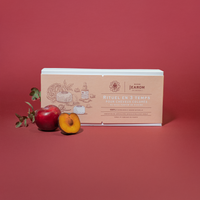
Organic virgin plum oil (INCI: Prunus Domestica Seed Oil), extracted from the first cold pressing of plum kernels, is a precious oil particularly suitable for hair sensitized by coloring.
Rich in essential fatty acids and naturally loaded with antioxidants, it compensates for the lipid losses caused by chemical processes. When hair is colored, part of its natural protection is altered. The fiber becomes drier, more fragile.
Plum oil acts as a repairing treatment.
It helps restore the hair's hydrolipidic film, which is essential for maintaining hydration and limiting the drying effects of water during washing. The fiber regains suppleness, softness, and substance. The hair ceases to be dry to the touch.
By restoring the cohesion of the fiber, it also allows for better light reflection. The surface becomes more regular, more luminous. The color appears deeper, more vibrant.
Its natural richness in antioxidants also helps protect the fiber against gradual dulling linked to daily aggressions.
It nourishes, but intelligently.
It repairs without suffocating.
Abyssinian oil: smooth and protect color
Abyssinian oil (INCI: Crambe Abyssinica Seed Oil) is known for its light texture and silky feel. Extracted from crambe abyssinica seeds, it has a natural affinity with the hair fiber.
Where plum oil deeply nourishes, abyssinian oil acts more on the surface.
It smooths the hair cuticles, which limits pigment loss during shampooing and improves color retention. The fiber appears more uniform, more brilliant. The hair reflects light better.
This action is particularly valuable for:
-
extending the intensity of chemical coloring,
-
limiting the bleeding of plant-based coloring,
-
maintaining the shine of color-treated hair wash after wash.
It also acts as a protective shield against daily aggressions: heat, pollution, UV. Without a greasy effect, without overload, it facilitates styling and reduces frizz.
It is the active ingredient that seals and enhances the fiber after shampooing.
Why their combination is ideal in a conditioner
Color-treated hair needs repair… but also protection.
Organic virgin plum oil restores and nourishes the weakened fiber.
Abyssinian oil smooths and protects.
Together, they strengthen the hair structure, reduce porosity, and prolong color intensity. The hair feels softer, shinier, and visibly healthier.
In a well-formulated natural hair care product, this synergy helps to sustainably preserve the beauty of color-treated hair, without compromising between performance and lightness.
In conclusion
A good conditioner for color-treated and damaged hair shouldn't just detangle after shampooing. It must act on the very structure of the hair to preserve the radiance and vitality of the color.
By favoring formulas rich in noble vegetable oils like organic virgin plum oil and abyssinian oil, you choose an approach that deeply nourishes, protects, and enhances the hair fiber.
Softer hair.
Shinier.
More intense color, for longer.